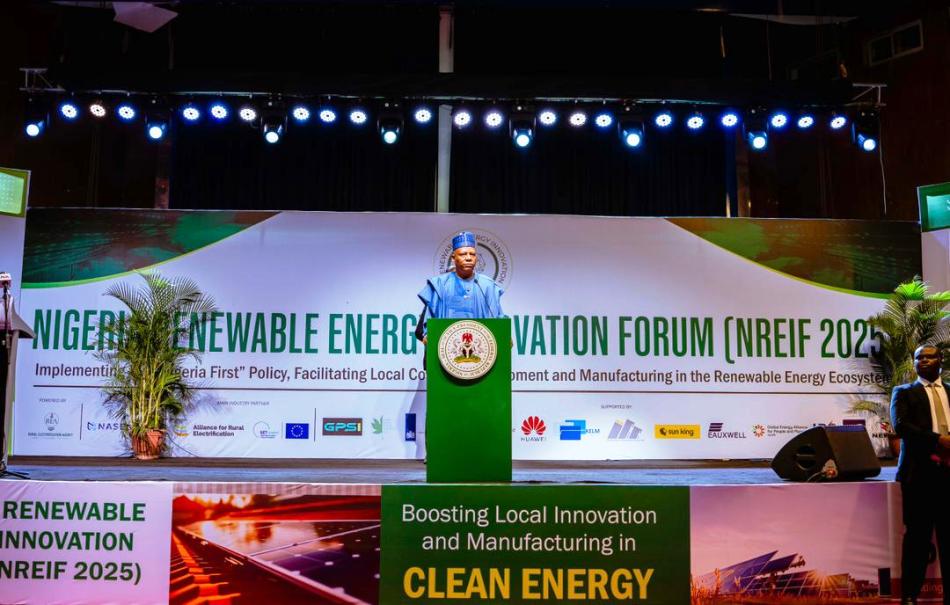
Nigeria’s Vice President, Kashim Shettima, has said the country’s energy transition agenda under President Bola Ahmed Tinubu is opening up investment opportunities valued at more than $410 billion between now and 2060, positioning Nigeria to become a driving force in Africa’s renewable energy revolution.
Speaking on Tuesday in Abuja at the inaugural Nigerian Renewable Energy Innovation Forum (NREIF) 2025, Shettima noted that an estimated $23 billion would be required to expand energy access and connect millions of Nigerians who still lack reliable electricity.
He emphasised that as the global community accelerates toward net-zero emissions, Nigeria and the African continent must not be left behind. According to him, Nigeria is endowed with critical minerals for clean technologies, a youthful population, and vast untapped renewable energy resources.
“We have too much at stake,” the Vice President said, urging stakeholders to harness the country’s resources and capital to cement Nigeria’s role as a leader in Africa’s renewable energy transformation.
Shettima disclosed that beyond improving access, Nigeria’s long-term ambition is to build a power system capable of delivering 277 gigawatts of installed capacity by 2060. Achieving this goal, he stressed, will require not only capital investment but also innovation, local capacity development, and sustained commitment.
He assured investors and development partners that the Tinubu administration is strengthening policy foundations to create a self-sustaining renewable energy market. Measures include enhanced incentives for local manufacturing, streamlined regulatory processes, and deeper collaboration with state governments and private investors to reduce risk and attract private capital.
Highlighting the government’s “Nigeria First” industrial strategy, Shettima said the country aims to anchor Africa’s renewable energy supply chains locally — from solar panel assembly plants in Lagos to battery recycling facilities across key industrial corridors.
He added that the Federal Ministry of Power is working on policies to foster a decentralised, competitive, and inclusive electricity market. However, he acknowledged that the energy transition cannot succeed without robust private sector participation, calling on development partners and original equipment manufacturers to localise technologies, strengthen value chains, and invest in skills transfer.
The Vice President also announced that over $400 million in new investment commitments had been mobilised through engagements at the forum. The investments, covering solar panel manufacturing, smart meters, battery storage, and recycling facilities, are expected to generate more than 1,500 direct jobs across several states.
Earlier, Minister of Power, Adebayo Adelabu, described NREIF as a turning point in Nigeria’s energy transformation, underscoring the importance of innovative partnerships in expanding local solar production capacity. He said the Federal Government’s multi-pronged strategy is designed to tackle structural challenges in the power sector while unlocking private investment across the value chain. He also referenced the Integrated National Electricity Policy as a comprehensive framework to consolidate reforms, including decentralisation efforts.
Managing Director of the Rural Electrification Agency, Mallam Abba Aliyu, said the forum bridges policy direction with research and innovation, accelerating Nigeria’s goal of building a sustainable green energy ecosystem. He reiterated that Africa must not lag in the global energy transition.
Representing UN Deputy Secretary-General Amina Mohammed, the United Nations Resident and Humanitarian Coordinator in Nigeria, Mohammed M. Malick Fall, affirmed the UN’s commitment to supporting Nigeria’s renewable energy ambitions and expanding access to power homes, schools, and communities.
Also speaking, the Dutch Ambassador to Nigeria, Bengt Van Loosdrecht, described the event as a milestone in Nigeria–Netherlands renewable energy cooperation, reaffirming his country’s commitment as a reliable partner in the sector.
At the event, governors from Jigawa, Bayelsa, and Ogun States, alongside the Rural Electrification Agency, signed several multi-million-dollar Memoranda of Understanding with private sector partners, including the Dutch government, to advance renewable energy projects nationwide.